Pir Azhar U Din
KORZOK, LADAKH | August 10, 2026
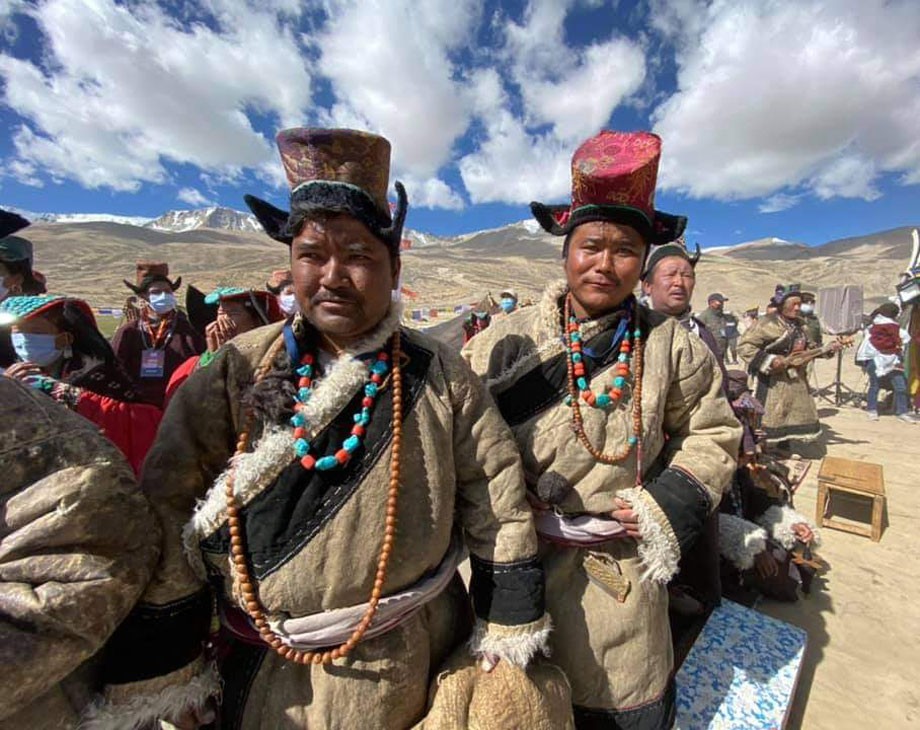
At Korzok, beside the blue waters of Tso Moriri, the traditional life of Ladakh’s Changpa nomadic community took centre stage as the Changthang Nomadic Festival brought together herders, local residents and visitors on August 9 and 10.
Held in the high-altitude Changthang region of eastern Ladakh, the two-day festival celebrated the community’s pastoral traditions, livestock, handicrafts, local food, traditional dress, music and dance.
More than 10,000 people, including local residents and foreign visitors, attended the festival, according to the Ladakh administration.
Behind the cultural performances and displays was a deeper story — the continuing relationship between Changpa families, their livestock and the Pashmina economy that supports many households across Changthang.
A livelihood shaped by livestock
For the Changpa community, livestock is central to everyday life.
Pashmina goats, yaks, sheep and horses are closely linked to the pastoral economy of Changthang. The community’s traditional Rebo tents, designed for a mobile way of life, also reflect the adaptation of nomadic families to the region’s harsh high-altitude environment.
The festival brought many of these traditions together at Korzok.
Traditional attire, music and dance, horse riding, archery, local cuisine, handicrafts and livestock displays gave visitors an opportunity to see aspects of a pastoral culture normally spread across the vast Changthang plateau.
For visitors, these were cultural displays. For Changpa families, they represented elements of their everyday lives.
Pashmina at the heart of Changthang’s economy
Pashmina remained one of the central themes of the festival.
The fine fibre produced by Changthang’s Pashmina goats forms an important part of the region’s pastoral economy and eventually reaches markets far beyond Ladakh.
During the festival, Lieutenant Governor Vinai Kumar Saxena distributed ₹1.10 crore in production-based incentives to more than 1,200 nomadic Pashmina herders.
The beneficiaries were mainly from Samad, Kharnak and Korzok, identified by the administration as major Pashmina-producing areas of Changthang. The assistance was transferred directly to the beneficiaries through Direct Benefit Transfer.
The support is aimed at strengthening Pashmina production while improving the economic sustainability of nomadic herding.
Raw Pashmina collection rises
The support comes as Ladakh’s Pashmina sector reports higher raw fibre collection.
According to the Ladakh administration, 19 metric tonnes of raw Pashmina had been collected by July 2026, compared with 16 metric tonnes during the entire year of 2025.
The administration has set a target of increasing average fibre production from around 200 grams per goat to at least 350 grams. It also aims to increase the Pashmina goat population from around two lakh to four lakh within three yearsthrough scientific breeding.
For herders, however, production is only one part of the economic equation. Timely payment for their produce remains equally important.
New mechanism aimed at faster payments
During the festival, the administration announced an ₹8 crore revolving fund for the All Changthang Pashmina Growers Marketing Cooperative Society, which operates the Pashmina dehairing plant in Leh.
Under the announced mechanism, herders are expected to receive 50 per cent of the Pashmina payment immediately, with the remaining amount to be paid within two months.
The administration said that payments had previously taken eight to ten months, creating difficulties for families dependent on the seasonal pastoral economy.
The new arrangement is intended to improve cash flow for producers and strengthen the Pashmina value chain from the herder to the market.
Preserving culture through a working livelihood
The Changthang Nomadic Festival was not limited to performances and cultural displays.
Its larger significance lies in the connection between cultural identity and livelihood.
The traditional Rebo, livestock, Pashmina products, handicrafts, food, clothing, music and dance all represent different parts of Changpa life. Preserving these traditions is closely linked to ensuring that pastoral families can continue to earn a livelihood from herding.
Under the production-based incentive announced during the festival, 60 per cent is to be reinvested in scientific breeding of Pashmina goats, while 20 per cent is intended for modern combing equipment and basic infrastructure. The remaining 20 per cent can be used by beneficiaries for household and personal needs.
The approach places the economic sustainability of herding alongside cultural preservation.
A festival centred on the people behind Pashmina
The Changthang Nomadic Festival offered visitors a closer look at a community whose traditional livelihood is practised across one of Ladakh’s most remote landscapes.
For two days, Korzok became a meeting point for Changpa herders, residents and visitors, bringing the community’s pastoral traditions into public view.
But beyond the festival grounds, the everyday work continued, caring for animals, producing Pashmina and maintaining a way of life shaped over generations by the Changthang landscape.
The Pashmina products that eventually reach markets far from Ladakh begin much closer to home: with Changpa families, their goats and the high-altitude grasslands on which their livelihood depends.
That connection between land, livestock, livelihood and culture remains at the heart of Changthang’s nomadic story.