By: Pir Azhar U Din
Mohammad Shafi Parray, a 47-year-old tailor from Nowgam, left his home late on Friday night with his usual calm and quiet focus. He had been called by the police that day not as a suspect, but to help stitch small cloth bags. These were to be used by the forensic team for packaging explosive samples taken from a massive cache seized in a terror-module case. He said goodbye to his wife and three children as always, confident that his work would be routine. By 11:20 PM, he was dead.
Shafi’s life was rooted in his craft and in his community. As the sole earner in his household, he ran a modest tailoring shop, his earnings supporting his family in a simple but dignified way. In the neighbourhood, he was admired for his humility, his skill, and his service. Across his home, relatives shared stories of his days at the mosque, where he was described as holding an unofficial but respected role in the local congregation, helping organise community efforts.
His involvement with the police was entirely professional. According to police sources, the explosive stash being sampled weighed around 360 kg and had been recovered from Faridabad in connection with a white-collar terror module. The materials included chemicals such as ammonium nitrate, potassium nitrate, sulphur, and other reagents , highly volatile when mishandled. The forensic team was breaking down the bulk into smaller samples over two days. DGP Nalin Prabhat said they were doing “sampling with utmost caution” due to the “unstable and sensitive nature” of the material. But even the best safety protocols could not avert disaster: an accidental detonation tore through the open compound of the Nowgam Police Station.
Shafi did not handle the explosives: his job was simply to stitch the small cloth bags that would hold the samples. Still, he was in the room when the explosion occurred. The DGP has been clear: there was no terror or sabotage element in what happened. He called it a “tragic accident not a deliberate act,” and the Ministry of Home Affairs echoed that position. Sadly, the blast killed nine people. Apart from Shafi, the deceased included one SIA officer, three forensic scientists, two crime-scene photographers, and two revenue officials. 32 more people were wounded among them, 27 police officers, two revenue officials, and three nearby civilians. The explosion also damaged large parts of the police station building and several adjacent homes.
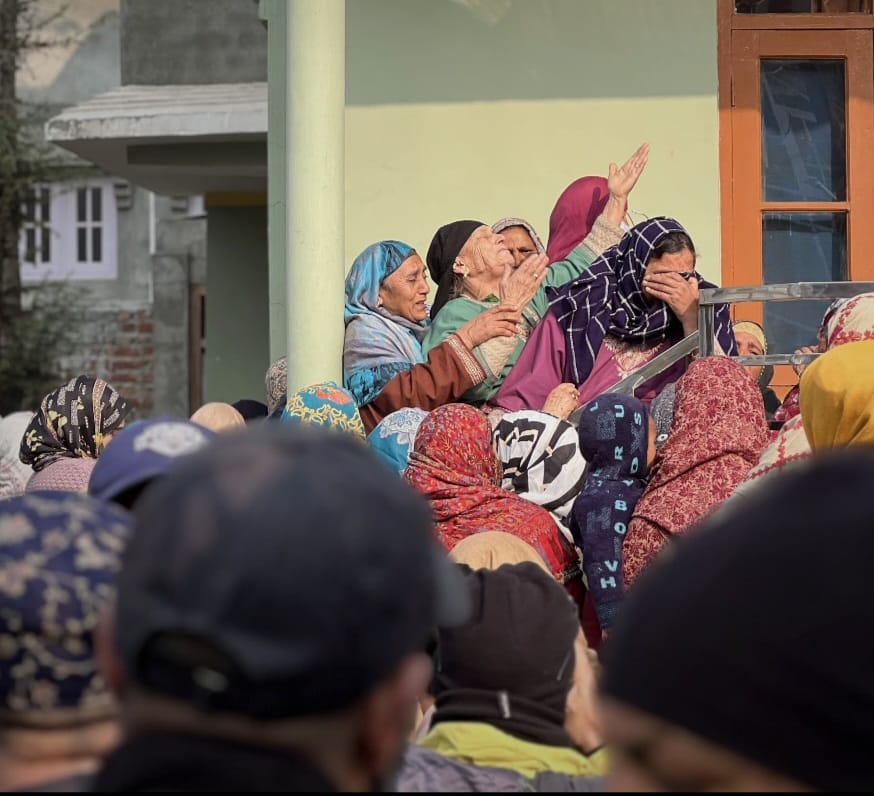
At Shafi’s house, the grief of the family was immediate and overwhelming. After being told that he was injured, his wife and children were later told that he had passed. Relatives stopped by, neighbours gathered all struggling to believe that a routine task could end so tragically. His cousin, Mohammad Ismail Sheikh, said that Shafi’s body was identified by his eldest son, turning an unfathomable loss into a deeply personal horror.
The neighbours described the moment they learned what had happened. Jawhar Ahmad Wani, living nearby, said that after hearing the blast, he rushed outside to help. “I found body parts at various places,” he said. Tariq Ahmad, another resident, told how he went with others to identify Shafi: “He did not have any legs,” he recalled, his voice trembling. In that moment, the community’s respect turned into quiet fury, not aimed at anyone, but at fate and at a government job and compensation to prevent Shafi’s children from being left without means.
Community members came forward with a clear and unified appeal: they want help for his family “He was the only one working … we ask the government to stand by them,” said one. In response, Health Minister Sakina Itoo, during a visit to Chancer in Kulgam, announced that the government would provide ₹ 10 lakh to the families of those who died in the Nowgam blast, and ₹ 1 lakh to the injured. That relief, she said, is being made available “as a mark of our commitment” to help those who suffered.
For Shafi’s family, however, a one-time compensation may not be enough. With their pillar gone, their future looks uncertain. The children reliant on him for everything, now depend on the government’s promise, the community’s support, and the justice of investigators examining how and why it happened.
Mohammad Shafi did not walk into the station to make a political statement, or to take a stand: he simply went to do a job he knew, and to help. He entered a room full of danger as a tailor. He left behind a family stricken by grief and a neighbourhood that still struggles to understand how a man of peace was swept up in murderous forces. In the rubble of the Nowgam station, his story wounded, human, and irrevocable remains.