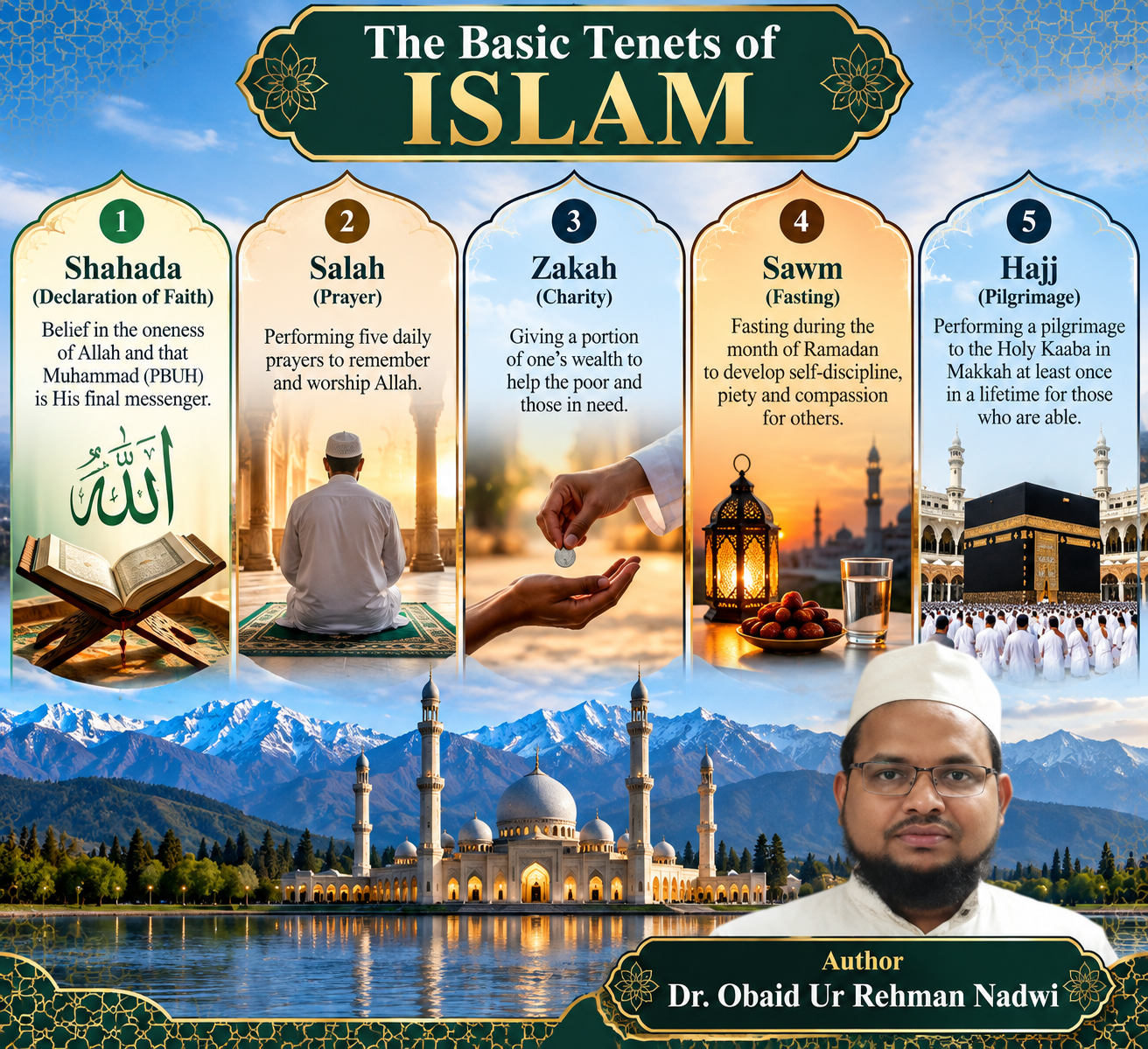
Dr.Obaidur Rahman Nadwi
The morals of Islam act on human nature in a way that is similar to that of fire, which purifies iron and melts it so that it can be moulded into a useful instrument. The credit for this comparative guideline goes to Prophet Muhammad (PBUH) who came on earth to guide people from darkness into light and lead them onto the path of salvation, progress and prosperity.
Needless to add, the religion that Prophet Muhammad (PBUH) brought is based on the concept of all human beings, regardless of caste, creed, colour, language, culture and origin, are from one community. In the words of the Holy Qur’an: “O mankind! We have created you from a single pair of male and female, constituted into diverse people and nations that you know and cooperate with one another. In the sight of Allah the best among you is the one who is most pious, most virtuous”. (49:13)
Unlike other religions, Islam is not only a religion but a complete code of conduct. Islam is an Arabic word which connotes submission, surrender and obedience. Its another literal meaning is “peace” and it signifies that one can attain real peace of body as well as mind only through submission and obedience to Allah.
We may easily comprehend from the above connotations of Islam that in the true sense entire creation of the world literally follows the religion of Islam. The sun, the moon, the earth, air, water, stones, trees, animals and other innumerable things found in this cosmos are thus Muslims. For all things run on a specific course and pronounce Allah’s praise and glorify Him. The holy Quran says, “The seven heavens and the earth, and all beings therein, declare His glory. There is not a thing but celebrates His praise; and yet ye understand not how they declare His glory! Verily He is oft-forbearing, Most-Forgiving (S.17, A.44)
The Holy Book further says, “Seest thou not that to Allah prostrate all things that are in the Heavens and on earth, the Sun, the moon, the stars, the hills, the trees, the animals and a great number among mankind?” (S.22, A.18)
In this context it would be apt to mention that three basic concepts of Islam as laid down by Prophet Muhammad (PBUH) and all Prophets who had been sent by Almighty Allah to this universe before him for the guidance of people are At-thowheed (The oneness of Allah); Ar-Risalah (Prophethood); Al-Aakhirah (Hereafter).
These three basic tenets are embodiment of all Qur’anic injunctions and the do’s and don’ts prescribed by prophetic traditions.
Now come to the three basic concepts of Islam. The first and foremost tenet of Islam is oneness of Allah. For real objective of life is attainment of pleasure of Allah. Almighty Allah alone deserves worship. There is no deity except Him. If we worship except Him, it would be an act of polytheism. In Islamic concept polytheism is an unforgivable sin. It is a contumacious treason against Him. This is a rebellion against the Creator. Almighty Allah forgives all sins except polytheism. The Holy Qur’an says, “Allah forgiveth not that partner should be set up into Him; but He forgiveth anything else, to whom He pleaseth; to set up partners with Allah is to devise a sin most heinous indeed” (4, A.48).
Abu Amr relates on the authority of Sufyan b. Abdullah that he said to Prophet, “O Apostle of Allah, tell me something about Islam that I may not require further elucidation from anybody. The Prophet (PBUH) replied: “Have faith in Allah, and stick to it firmly.” Abdullah bin Busre reports that a person said to the Prophet (PBUH), “O Apostle of Allah! I have known many commandments of Islam (but it is difficult for me to act on them simultaneously) therefore, tell me the one which I can make the passion of my life.” The Prophet( PBUH) said, “Keep your tongue wet with remembrance of God.”
The second tenet of Islam is Prophethood. The Holy Qur’an says: “There is no nation to whom a Warner has not been sent” (35:24). To every people We sent a Prophet to teach them to worship Allah and to avoid evil….”(16:36). O ye who believe, believe in Allah and His apostle and the Book (Qur’an), which He hath sent down to His apostle and scriptures which He hath sent down formerly. Whoever denieth Allah and Hiangelses and His Books and His apostles and the Last Day hath strayed far from the truth (4:136) “We have sent to mankind messengers proclaiming the truth and warning that men may henceforth have no excuse for ignorance” (4:16)
It should be kept in mind that besides having reposed faith in all prophets and apostles, Muslims must also believe that Prophet Muhammad (PBUH) is the last Prophet of Allah and there would be no Prophet after him. If anyone claims to be a Prophet of Allah after him, he would be a lair and an imposter. Almighty Allah sent a good number of Prophets for guidance of mankind but the Holy Qur’an has only mentioned 25 of them. The main plank of all Prophets was to emancipate the people from superstitions and uncertainties and lead them to the right path.
The third concept of Islam is Hereafter. Contrary to other faiths, Islam has a unique and different concept regarding the Day of Judgement. It would not be an exaggeration to say that whole gamut of Islamic life depends on the Hereafter. The Holy Qur’an says, “What is the life of this world but amusement and play? Man’s real home is in the Hereafter, if
only he knew.” (29:64)
It should be noted that for a Muslim whatever he does in this world is for the Hereafter.
That is why the real life of believers is the life to Hereafter. A Muslim shirks in committing
unholy acts for he will have to be accounted for them before Allah on the Day of Judgement. No doubt, the fear of the Hereafter keeps Muslims away from perpetrating all sorts of evil acts.
The Holy Qur’an says, “the dwellers of paradise will ask the inmates of Hell, what brought ye into Hell-fire? They will reply, “We were not of those who observed the prescribed prayers, and we were not of those who fed the poor, and we indulged in vain talk with idle thinkers, and we questioned the happening of the Day of Judgement, till death overtook us” (Q:74: 42-47)
In a nutshell, a Muslim cannot be perfect, unless he adheres to the above-mentioned tenets of Islam. It is therefore a bounden duty of all Muslims to carry out the teachings of Islam and lead their lives as Almighty Allah stands for His beloved Prophet Muhammad (PBUH) and asks him to say: “Lo! My worship and sacrifice and my living and my dying are meant for Allah, Sustainer of the worlds.”
Dr.Obaidur Rahman Nadwi
Faculty Member
Darul Uloom Nadwatul Ulama
Lucknow, U.P.( India)